Set the holiday watering answer before you pack

Product feature overview

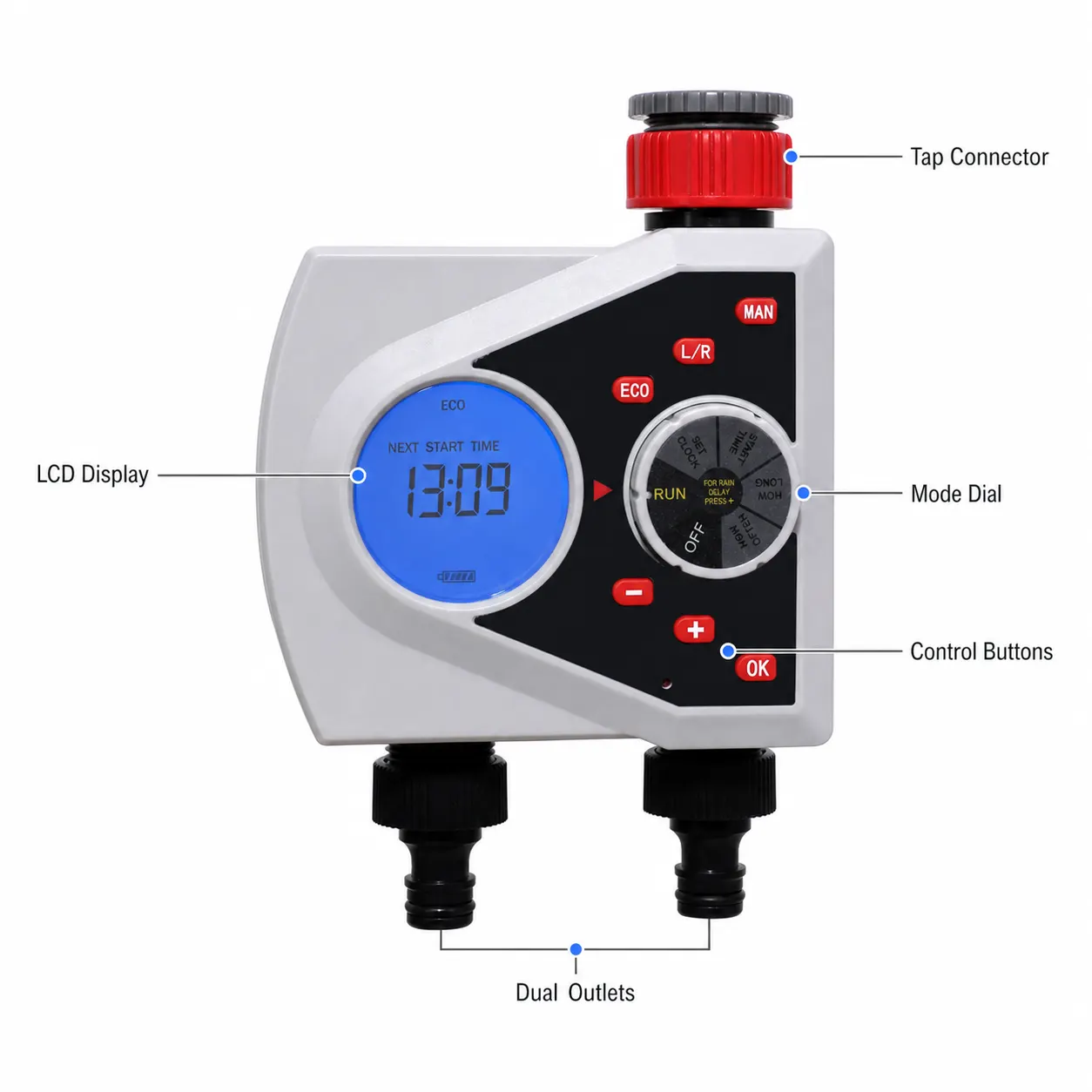
For watering while on holiday garden pots UK, the practical answer is to split the garden into zones, test the flow before travelling, and avoid relying on one watering time for every plant. Patio pots, tomatoes and growbags usually dry faster than established beds, so a two-outlet tap timer can be useful when one outdoor tap needs to serve two areas. The Aqualin Garden Water Hose Tap Timer has two independent outlets, and each outlet can be set with its own start time, frequency and duration, giving you a way to avoid a single compromise schedule.

The job is not to make the garden look after itself without thought. It is to make the week away less risky by turning a rushed manual routine into a checked, repeatable setup. Before leaving a Bristol patio, a Leeds greenhouse bench or a Surrey kitchen-garden path, the useful work is simple: decide which plants need the most regular water, connect the timer without tools using the swivel coupling, run both lines manually, look for dry patches or pooling, then set the routine only after you have seen where the water actually lands.

Match the UK garden setting to two watering zones

A typical holiday problem is not one garden, one need. A row of black nursery pots beside a south-facing wall can dry quickly, while a border bed or raised vegetable bed may hold moisture for longer. If both areas are fed from the same outdoor tap, one schedule can easily be wrong for one of them. The documented strength of this hose timer is that the two valves are independent: each outlet can have its own start time, watering frequency and duration, rather than forcing patio containers and a second hose line to behave as if they were the same job.

Think of the setup from the tap outwards. Outlet one might serve the patio containers or growbags nearest the house, where drying is fastest and mistakes show quickly. Outlet two might serve a bed, greenhouse line or separate row of pots that needs a different rhythm. The timer supports watering duration from 1 to 240 minutes, with frequency choices of every 4, 6 or 12 hours, or every 1 to 15 days. Those ranges give room to start modestly, observe the result, and adjust before the suitcase is closed.

Check the documented timer facts against the plants

The product facts worth using are the ones that change the buying decision. This is a white plastic hose timer controller with two independently scheduled outlets, a backlit LCD screen, a rain delay function, manual watering and battery operation requiring two AA batteries, which are not included. It is described as easy to install, with a swivel coupling for quick connection without tools. Those facts matter because a holiday setup has to be understandable under time pressure: if you cannot read the screen, check the settings and start a manual test, the timer becomes another thing to worry about.

Do not turn those facts into promises they do not make. The input does not document hose length, tap thread compatibility, water pressure requirements, dripper performance, coverage area or suitability for every irrigation accessory. That means you should check your own hose, connectors and watering line before relying on it. The timer can open and close its two valves according to a programme, but it cannot prove that every pot receives equal water. Uneven slopes, blocked drippers, kinked hose, loose joints and containers with poor drainage still need human checking before travel.

Use a pre-holiday checklist at the patio tap

A useful checklist starts with the tap, not with the plants. Fit fresh AA batteries, because the timer requires two and they are not supplied. Attach the unit to the outdoor tap using the swivel coupling, then connect the first hose or irrigation line to outlet one and the second line to outlet two. Use manual watering mode on each outlet for a short test, watching the actual flow at the far end of the line. Check that the connections stay dry, the hose is not kinked, and water is reaching the intended pots rather than running across paving.

Next, set only one decision at a time. For the faster-drying group, choose a start time, frequency and duration that you can test while you are still at home. Then programme the slower group separately, rather than copying the first setting out of convenience. After the first run, lift a pot if practical, feel the compost surface, and look for water collecting in saucers or running straight through. Use rain delay only when wet weather makes a planned watering unnecessary; it can skip watering for 0, 24, 48 or 72 hours without rebuilding the programme.

Spot mismatches before leaving the house

This kind of timer is a poor match for anyone who needs a fully specified, all-in-one irrigation kit with documented pipe sizes, drippers, coverage plans and compatibility details included in the product facts. The supplied facts cover the timer and its control functions, not a complete watering layout. If your worry is whether a particular micro-irrigation brand, old greenhouse pipe or unusual tap thread will fit, that needs checking against your own equipment. It is also not the right article to claim a guaranteed result for fragile plants during a heatwave, because the evidence provided does not support that level of certainty.

There are also practical limits around trust. If you have newly planted tomatoes in growbags, a collection of small terracotta pots, or a greenhouse that overheats quickly, a timer should reduce labour rather than remove observation entirely. Ask a neighbour for one visual check if the plants are high value or the weather forecast is extreme. If local hosepipe restrictions are in place, check your own water company’s current rules before using any hose-connected watering arrangement. A rain delay is a control feature, not proof of legal compliance or a weather-aware system.

Compare neighbour watering with a two-outlet timer

Neighbour watering can work well when the task is tiny: a few pots by the back door, clear instructions and a short trip. It becomes awkward when the garden has two areas with different needs, or when a helpful person has to remember which tomatoes need more water and which border should be left alone after rain. A two-outlet timer can reduce that social burden because the routine is set at the tap, and the manual watering function still lets you or a helper run a controlled watering cycle without dismantling the programme.

The comparison is not about replacing common sense. A neighbour can notice a fallen cane, a leaking connector or a pot that has blown over; a timer cannot. The timer’s advantage is repeatability: separate outlet schedules, durations from 1 to 240 minutes, and frequency options that can be set for different garden zones. The human advantage is judgement. For a week away from a Manchester terrace or a Kent vegetable patch, the strongest arrangement may be a tested two-zone timer routine plus one simple human check, rather than asking someone to hand-water everything from memory.

Plan pots, tomatoes and beds as separate jobs

For containers, the key check is speed of drying. Small pots, hanging baskets and tomatoes in pots or growbags can lose moisture quickly, especially on warm paving or in a greenhouse. Put these together only if they behave similarly, then use one outlet for that higher-attention group. During testing, run the manual watering function and watch whether water reaches the root zone or simply escapes through the bottom. The documented timer range gives flexibility, but the right duration still depends on the container, compost, weather and line layout in your own garden.

For beds, borders or larger vegetable areas, the aim may be steadier and less frequent watering. These can sit on the second outlet if the hose route and watering line support it. Because each valve can be scheduled independently, the bed does not have to share the same timing as patio pots. This matters for water-conscious households as well as holidaymakers: controlled watering is more deliberate than leaving a hose running casually. Still, if two outlets are used at the same time, your own water pressure and line performance need checking, because the product facts do not provide a pressure guarantee.

Choose the next step for a safer week away

The next step is a rehearsal, not a purchase decision made from a feature list alone. Lay out the actual hose lines in the place they will sit while you are away, attach the timer, fit the required batteries and run both outlets manually. Look at the last pot on each line, not just the first. If the far end is weak, shorten the run, adjust the layout or split the job differently. If water pools, reduce the duration or change the plant grouping. A holiday watering plan should be boring before you leave: known settings, checked flow and no mystery connections.

If the garden has one outdoor tap and two areas that genuinely dry at different rates, the Aqualin two-outlet hose timer is worth considering because the documented facts match that problem: independent outlet schedules, manual watering, rain delay, a backlit LCD and tool-free installation. If your real need is a complete drip kit, verified compatibility with existing fittings, app control, or a legally assured answer during local restrictions, resolve those questions before buying. For most UK patio-and-bed holiday setups, the sound next step is to test a modest two-zone routine several days before travel, then adjust from what the plants and soil show you.