
Short answer: A garden hose timer can help organise holiday watering, but it cannot guarantee that every pot receives the right amount of water. The Hosetimer listing has two independent outlets, separate schedules, a 1-240 minute duration range, several frequency choices and a rain-delay function. It needs two AA batteries, which are not included. Before relying on it while away, check the tap connection, hose layout, emitter or sprinkler choice, drainage and the water demand of each plant. Flow rate, pressure, coverage and plant-specific results are manufacturer does not specify on the current product page.
Plan the holiday watering job first
A timer controls when water is released; it does not decide whether the water reaches every container evenly. Before buying, map the garden into watering groups and note which pots, beds or baskets dry quickly. A sunny hanging basket and a shaded border should not automatically share one schedule.
RHS advice recommends checking container moisture and considering a self-watering system when you are away. That is a useful reminder that the timer is one part of the setup. The hose route, outlet hardware, drainage and plant demand still decide whether the result is sensible.
| Planning question | What the product lists | What you still need to check |
|---|---|---|
| How many groups? | Two independent outlets | Whether two groups are enough |
| How long? | 1-240 minutes | How long your emitters need |
| How often? | Every 4, 6 or 12 hours or every 1-15 days | The plants' actual moisture needs |
| Will it reach? | Not stated | Hose layout, flow and coverage |
Use the two outlets carefully
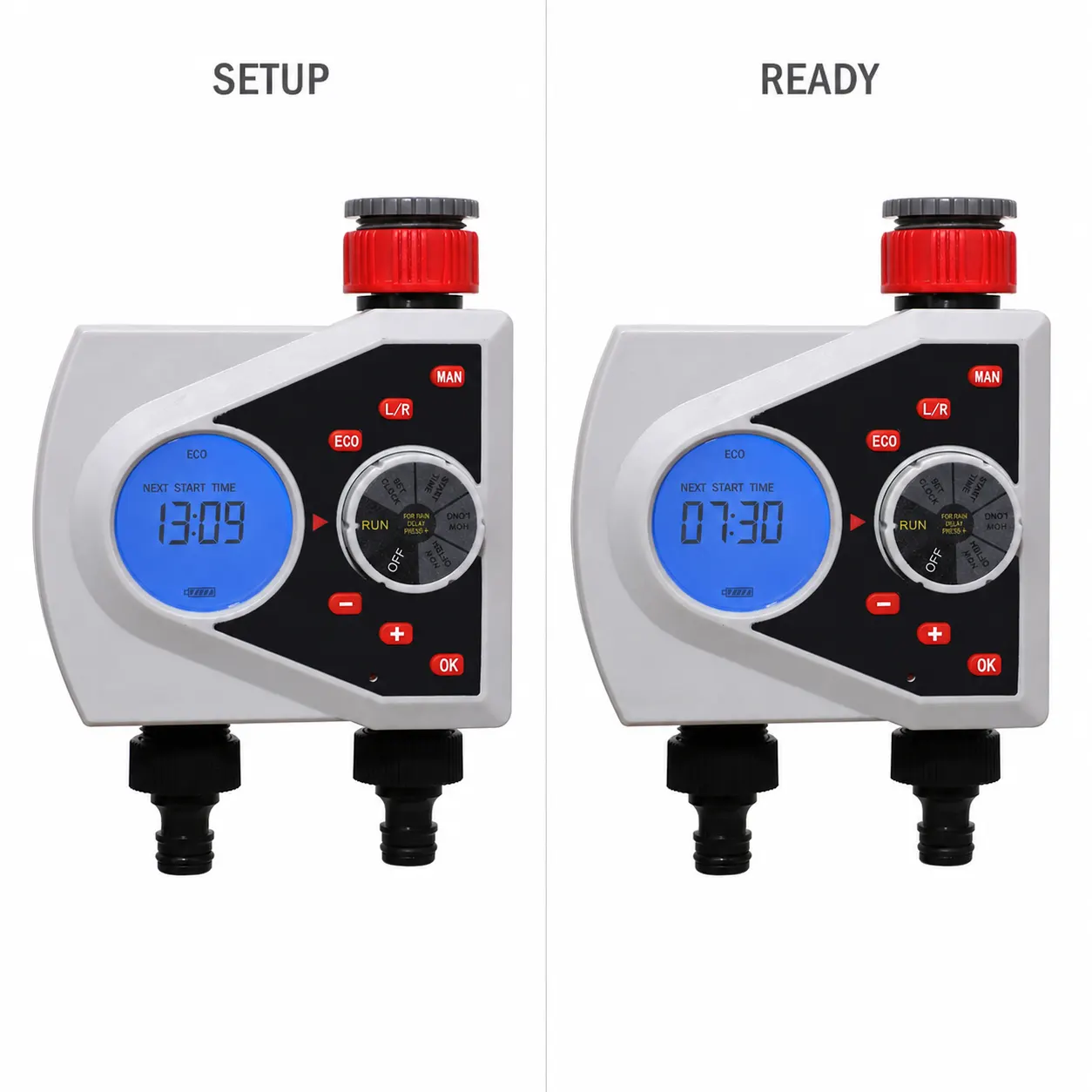
The current page says each outlet can have its own start time, frequency and duration. That is useful when one outlet serves containers and the other serves a bed or a different watering device. It is not evidence that both outlets deliver the same volume or work at the same pressure.
The listing also describes a tool-free swivel coupling and a rain delay of 0, 24, 48 or 72 hours. Test the arrangement before leaving. A schedule that looks correct on the display can still fail if a hose is kinked, an outlet is blocked or a connection drips.
- Group plants by similar water demand and exposure.
- Connect the two outlets to the intended hoses or watering devices.
- Check every joint and hose route for leaks, kinks and blocked ends.
- Set a conservative schedule and observe the wetting pattern before departure.
- Use rain delay only after checking whether the plants and weather actually justify skipping.
Do not turn a schedule into a guarantee
RHS guidance notes that containers can dry quickly and that grouping them in a shaded, sheltered place can reduce moisture loss during a holiday. A timer does not remove that environmental effect. Wind, sun, container size, compost and drainage can change the result from one pot to the next.
The product page does not state flow rate, pressure range, tap-thread standard, hose reach, coverage area or plant-specific watering results. Manufacturer does not specify those details. Check the actual installation with the water source and fittings you plan to use.
Final checks before you leave
The timer requires two AA batteries, not included, and offers manual watering as well as scheduled watering. Fit fresh batteries, confirm the clock and run both outlets before the trip. If the garden is valuable or the absence is long, ask someone to look at the system rather than relying on an unobserved first setup.
Choose the product when two timed hose outlets match your layout and you are willing to test the whole watering system. Do not buy it expecting a known coverage figure or a plant-care guarantee that the listing does not publish.
Related guides and product details
Use the Hosetimer as a scheduling controller within a tested watering setup, not as proof that holiday plants will receive perfect coverage. Read Tap Timer for a Garden Hose While Away for related guidance. Read Watering Garden Pots While on Holiday in the UK for related guidance. Review the documented specification on the Garden water hose tap timer with two outlets product page before ordering.
Sources and safety context
- Supports the two outlets, timing ranges, rain delay, manual watering, battery requirement and coupling description. Current Hosetimer product page.
- Supports checking container exposure and using practical holiday watering arrangements. RHS: How to look after your garden on holiday.